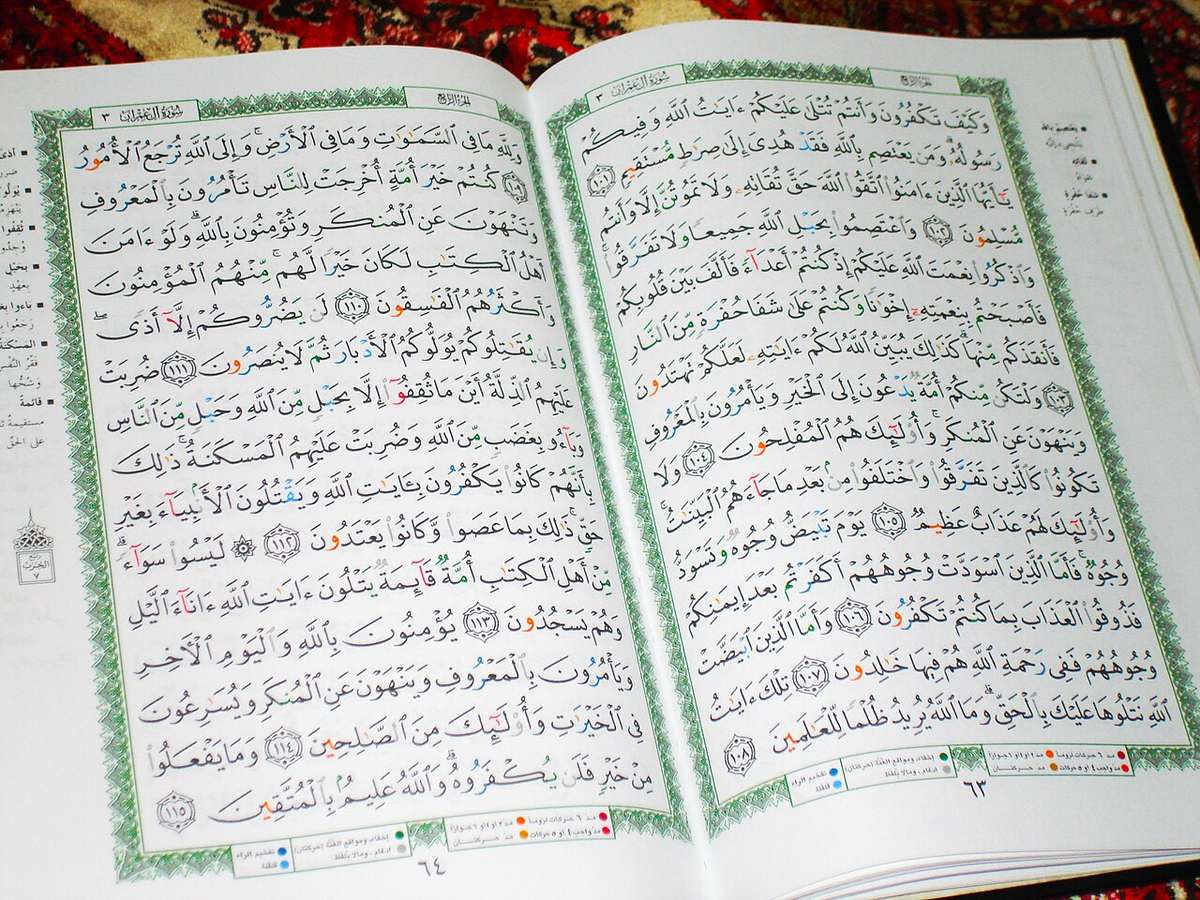
Photo by Amr Fayez (TheEgyptian) (CC BY 2.5), from Wikimedia Commons.

Where should we begin?
Begin smaller than you think. Many parents start with a long list of goals: the whole alphabet, the rules of tajweed, a surah a week. Within a month the child is tired and the parent feels guilty.
A better start is one small thing done well every day. For a young child that might be three or four letters. For an older child it might be one line read slowly and correctly. The aim of the first few weeks is not progress. It is the habit.
How long should each session be?
For most young children, ten to fifteen minutes is enough. Older children can manage longer, but even they do better with a short session they finish happily than a long one that ends in tears.
Daily matters more than long. Ten minutes every day will carry a child further than an hour on Saturday. If a day goes badly, keep the session but make it shorter. Do not skip it. The child learns that the Qur'an comes every day, whatever else happens.
Why learn the letters before the rules?
Tajweed rules make sense only once a child can see and say the letters without effort. If you teach rules too early, the child is trying to remember two things at once and does neither well.
So spend real time on the letters. Learn how each one sounds, then how it looks at the start, middle and end of a word, then how the short vowels change it. Only when the child can read short words smoothly is it time to add rules, one at a time.
This stage can feel slow. It is not wasted. A child who knows the letters well reads faster later and makes fewer mistakes that are hard to undo.
Does listening and repeating help?
Yes, and it is one of the easiest things to do at home. Children copy what they hear. Play a clear, slow recitation of a short surah, then let the child repeat it a line at a time.
Choose one reciter and stay with them for a while, so the child hears the same rhythm each time. Short surahs from Juz 'Amma, beginning with Surah al-Fatihah, are a natural place to start. Listening in the car, at breakfast or before sleep all counts.
Listening does not replace reading from the page, but it trains the ear, and a good ear makes reading easier.
When in the day works best?
Put the Qur'an first, while the child is fresh. For many families that means after Fajr or straight after breakfast, before school work, screens or play.
A tired child at the end of the day can still listen and repeat, but reading new letters is hard work for the brain. Give that work the best part of the day. Keep the same time each day where you can, so nobody has to decide whether today is a Qur'an day.
What if I cannot read the Qur'an well myself?
Many parents worry about this, and it should not stop you. You can still do a great deal.
- Set the time and keep it. The routine is the parent's job, and it is the part that matters most.
- Sit with your child. Your attention tells the child this is important.
- Use recordings. Let a good reciter be the voice, and you be the one who presses play and listens alongside.
- Learn beside them. Children are not put off by a parent who is learning too. Many are encouraged by it.
What you should avoid is correcting a child with a sound you are not sure of yourself. If you are unsure, say so, and check it with a recording or a teacher.
When is it time to get a teacher?
A parent can build the habit and teach the early letters. A teacher becomes important when the child is reading words and needs someone to hear every sound and correct it. Mistakes in pronunciation are much easier to fix early than late.
It is also time when the routine keeps slipping, when the child responds better to someone outside the family, or when you want to learn properly yourself. A teacher does not replace your part at home. The daily practice still happens with you.
What to do next
If you are not sure where your child is, our free placement test is a quiet way to find out. Our Qur'an and Islamic Education classes are for girls and women, and boys aged 6 to 12, and you can read about them on the Islamic Education page. For practice at home, there are free printables and learning games you can use today.
Published 13 November 2026.